Automated Shopify Customer Intelligence, Not Manual Spreadsheets
RFM customer segmentation and trigger-based automation run automatically off your real Shopify data — no rules to write by hand, no manual scoring.
Every customer, scored and segmented automatically
RFM (Recency, Frequency, Monetary) analysis used to mean building a spreadsheet formula and re-running it every month. SnapDash calculates it continuously from your real order history and re-segments customers the moment new data syncs in — so you always know who your Champions are and who's slipping into At Risk.
- Automatic RFM scoring, 1–5 scale
- 5 customer segments, always current
- 9 real-time automation triggers
- Cohort retention heatmap
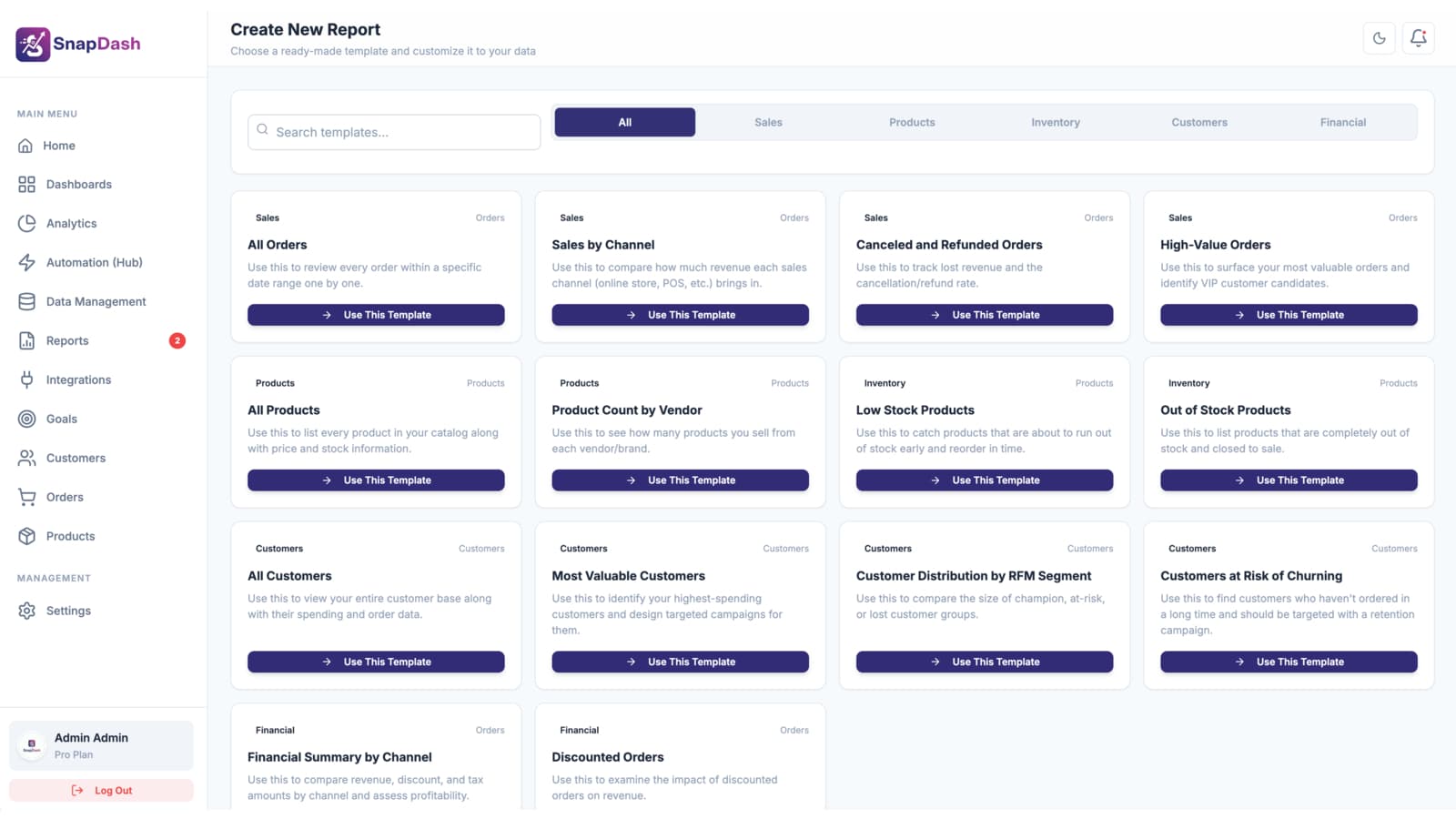
5 segments, calculated from real order behavior
| Segment | What It Means |
|---|---|
| Champions | High recency, frequency, and monetary score — your best customers. |
| Loyal | Frequent buyers with solid recency, even if spend is moderate. |
| At Risk | Used to buy often, but recency has dropped — a signal to re-engage before they leave. |
| Lost | Low recency, frequency, and monetary score — customers who have gone quiet. |
| Hibernating | Everyone else — customers worth watching but not yet in a clear pattern. |
From insight to action, without manual steps
9 Real-Time Triggers
New order, payment received, low stock, product out of stock, new customer, order refunded, sales spike or drop, and scheduled checks — fired directly off real Shopify events.
5 Automated Actions
Send an email, tag an order or customer, generate and email a report, or call a webhook — chained directly to any trigger with no manual step in between.
Sales Spike & Drop Detection
SnapDash compares current sales velocity to the prior week automatically and can trigger an alert the moment a meaningful swing happens.
Cohort Retention Analysis
See what percentage of each month's new customers come back to buy again in the following months, visualized as a retention heatmap.
Yes. Every customer with at least one order is scored 1–5 on Recency, Frequency, and Monetary value using quintiles calculated from your store's own order history, then automatically placed into a segment — no manual scoring or spreadsheet work.
Champions score 4+ on all three dimensions. Loyal customers score 4+ on Frequency and 3+ on Recency. At Risk customers have low Recency (2 or below) but Frequency of 3+. Lost customers score low across Recency, Frequency, and Monetary. Everyone else falls into Hibernating.
SnapDash's segmentation and automation logic is a deterministic, data-driven engine — not a generative AI chatbot. It automatically scores, segments, and triggers actions off your real Shopify events without needing you to write rules by hand.
Nine triggers are available: new order (with a minimum amount), order paid, order shipped, low stock, out of stock, new customer, refund created, a sales spike or drop versus the prior week, and scheduled daily or weekly checks.
Yes. After every Shopify sync, customers affected by new orders are automatically re-scored and, if needed, moved into a new segment.
Yes. RFM segmentation, cohort analysis, and the automation engine are all included in SnapDash at no cost during our public launch.
Explore the rest of SnapDash
Every part of SnapDash connects to the rest — see how each piece fits together.